
Detroit Warrant Checks
Detroit offers more self-service warrant check channels than any other Wayne County city. Try them in this order.
- Search the 36th District Court case inquiry by name or case number for a public case filed since 1990.
- Send the court's Traffic Information Inquiry to ask for warrant, bond, and balance information on your own case.
- Search Third Circuit Odyssey when the matter is a felony or a Circuit capias.
- Call the traffic and criminal division at (313) 965-5113 if the online channels leave a question open.
- Use a police records request only for records the Detroit Police Department holds, not for a court status.
Note: A court records request in Detroit is submitted in person, and warrants are excluded from public viewing.
The Detroit Traffic Warrant Inquiry
The 36th District Court runs a request form that asks the court to look into traffic and criminal warrant information, bond, and any balance due on a ticket. Detroit's most specific official warrant channel is this one. It is a form, though, not an instant lookup. You fill out the inquiry form with your date of birth, mailing address, and a contact email, and the court replies after processing.
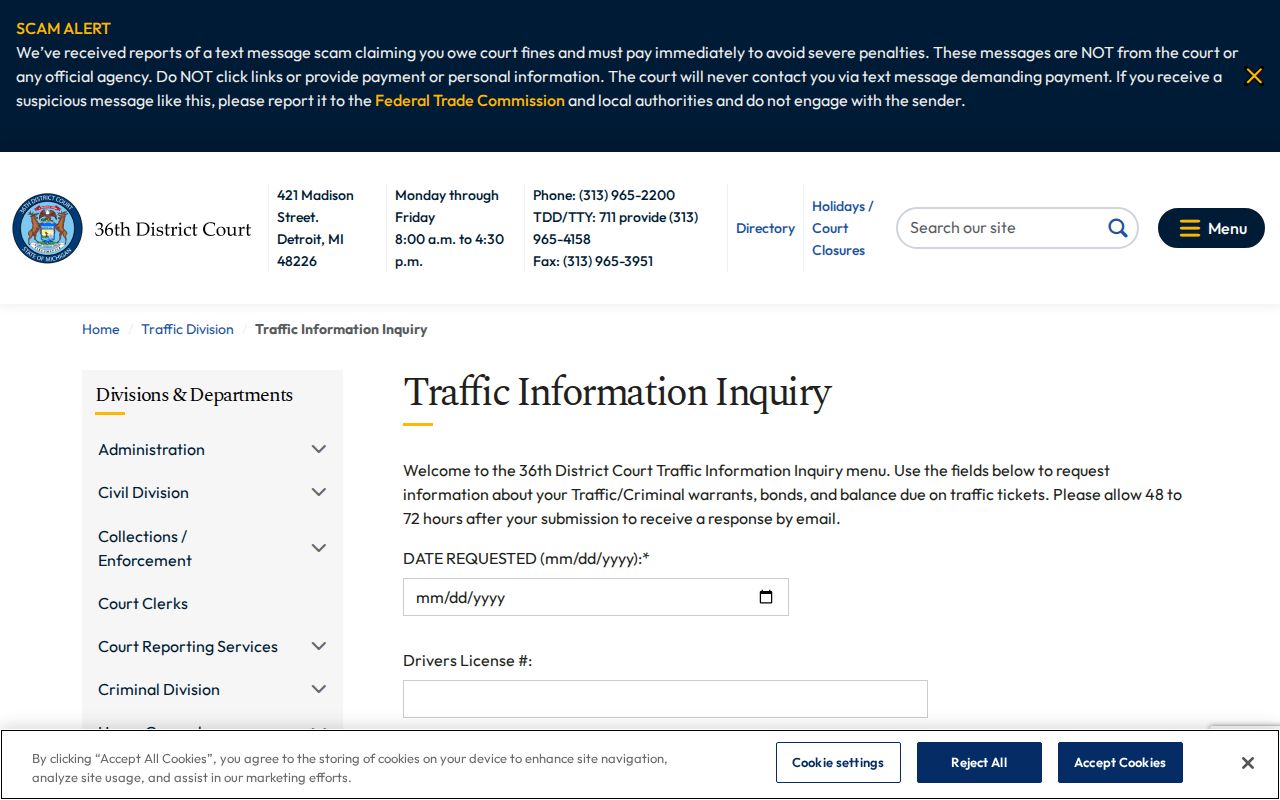
The form wants the date requested, your date of birth, first and last name, mailing address, city, state, ZIP, email, and phone. Middle name and driver's license number are optional. Detroit's court asks for 48 to 72 hours to respond.
Policing and Courts in Detroit
Here is how Detroit divides the work. Police investigate cases, make arrests, and run the Court Liaison Office that pushes warrant paperwork into the state system. The 36th District Court hears city traffic, ordinance, misdemeanor, and felony preliminary matters, and it sets bond and takes payments. Once a Detroit felony is bound over, the Third Circuit Court picks it up, while the 36th keeps the misdemeanor and traffic docket.
Detroit Police Department
Records requests through the DPD Law Unit, 2 Woodward Avenue, Suite 500
The court homepage carries the current announcements, hours, and contact header.
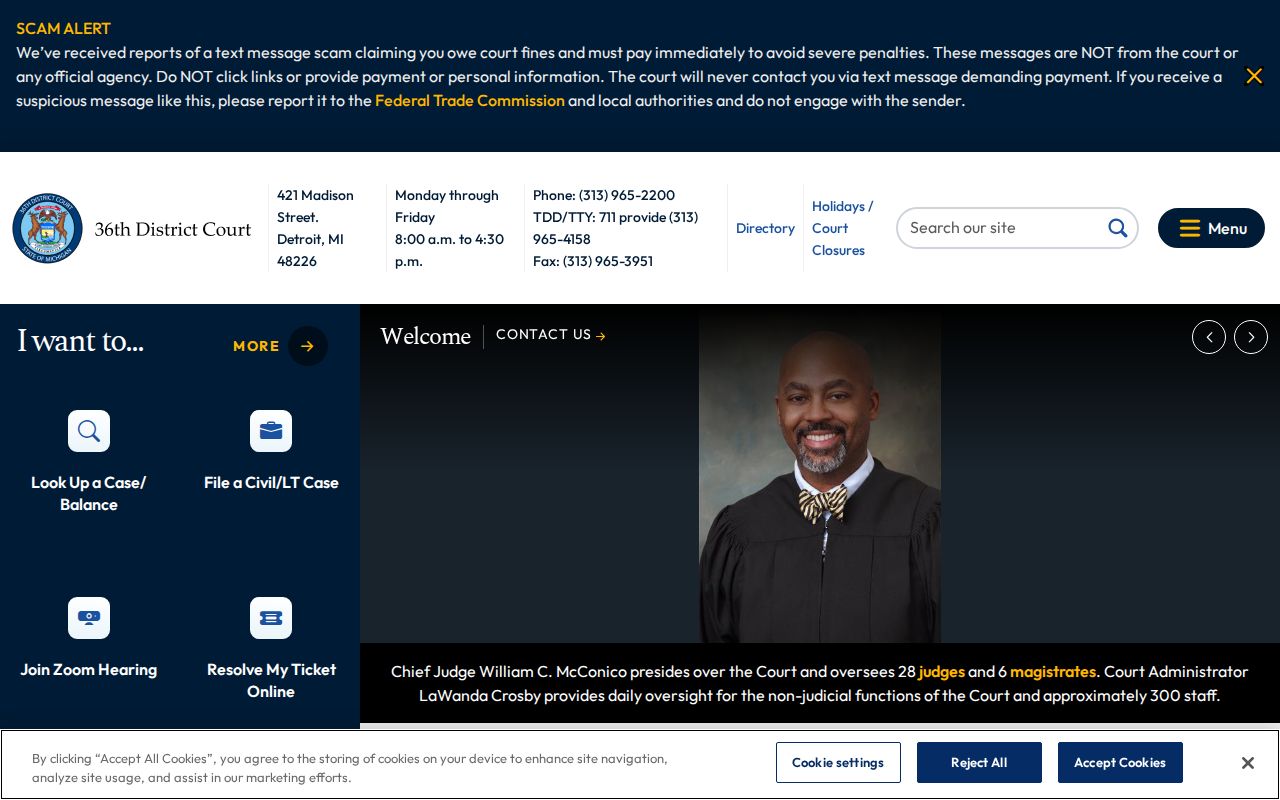
Notices like the 2026 amnesty window appear there first. Check that page before trusting an older Detroit announcement.
Detroit Case Inquiry and Warrant Records
The free case inquiry opens the public registers of action for 36th District Court cases filed from 1990 forward. It shows case events and balances. It does not show document images, and a schedule search stops at 1,000 results. The case inquiry page spells out these public access controls before you search. One caution: the court says the information is not certified and cannot serve for background checks. For Detroit warrant records, treat it as a first look, not the last word.
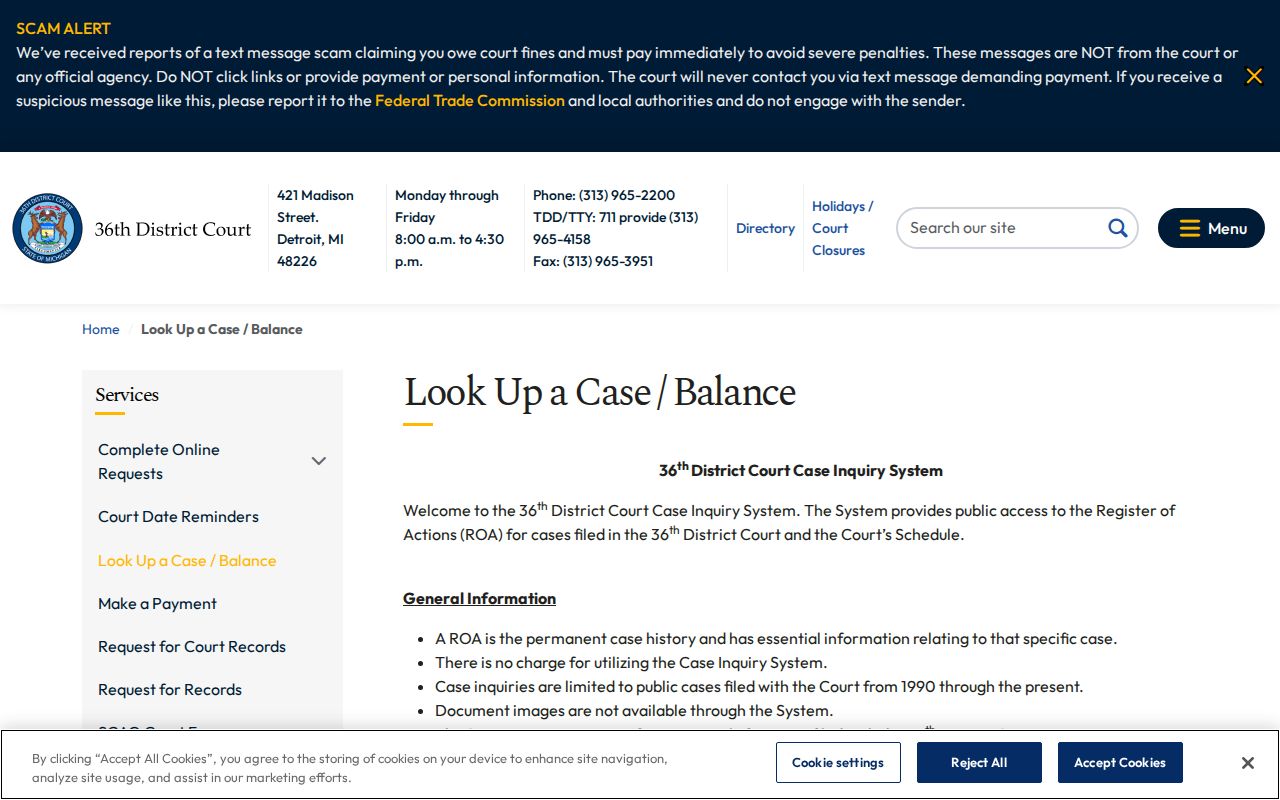
Use it to pull a case number, then confirm the warrant position with the Detroit court itself. A blank schedule result is not a clearance, since the public view can hide the warrant line.
Warrants in Detroit: The Main Types
Detroit produces every warrant type in Wayne County, and the label on the paper tells you which office handles it. Traffic and ordinance warrants stay at the 36th. Circuit warrant work runs through the Third Circuit Criminal Division.
| Warrant Type | How It Arises | Who Issues It |
|---|---|---|
| Traffic warrant | Unanswered or unpaid Detroit citation | 36th District Court |
| Bench warrant | Missed court date or unmet court order | The judge in the case |
| Capias | Missed felony or Circuit setting | The district or Circuit judge |
| Arrest warrant | Charge filed after a police investigation | A judge or magistrate |
| Support warrant | Failure to comply with a family order | Third Circuit Family Division |
What Happens After a Detroit Capias
Detroit calls it a capias: an arrest order that follows a missed felony, high misdemeanor, or Circuit setting. The police manual lays out the machinery behind it. Court liaison staff forward the order, and command staff complete a warrant information card plus a hold or notification card, which travel through records and identification for entry into the law-enforcement network. None of that is a public search field, and you cannot query the network yourself. What it does tell a Detroit reader is timing. An active warrant sits in that network until an arrest happens or the judge enters a recall. The recall, not the paperwork, is the event that ends the order.
Detroit Warrant Records: What They Show
A Detroit warrant record ties one person to one case in one court. Read the identifiers first and the amounts second, because a name alone proves little in a city this size. Note that the court keeps warrants out of public viewing and out of certified copies, so a records request may return the case file without the warrant paper itself.
| Case number | The court identifier, in a format such as 2026-004567-TR. |
|---|---|
| Charge or violation | The offense, its class, and any count number. |
| Issuing court | The 36th District Court, or the Third Circuit on a felony. |
| Balance and bond | Fines, costs, late amounts, or a bond set for a future date. |
| Status | Open, active warrant, recalled, served, or closed. |
Detroit Warrant Payment Routes and Payment Plans
Detroit collects court money through more channels than any other Wayne County venue. Pay online, call the 24-hour bilingual line at 1-855-798-1547, use a payment kiosk, mail a check, drop the lobby box, or see the cashier. No cash in the mail or drop box. The payment page lists every channel, the phone line, and the kiosk locations.
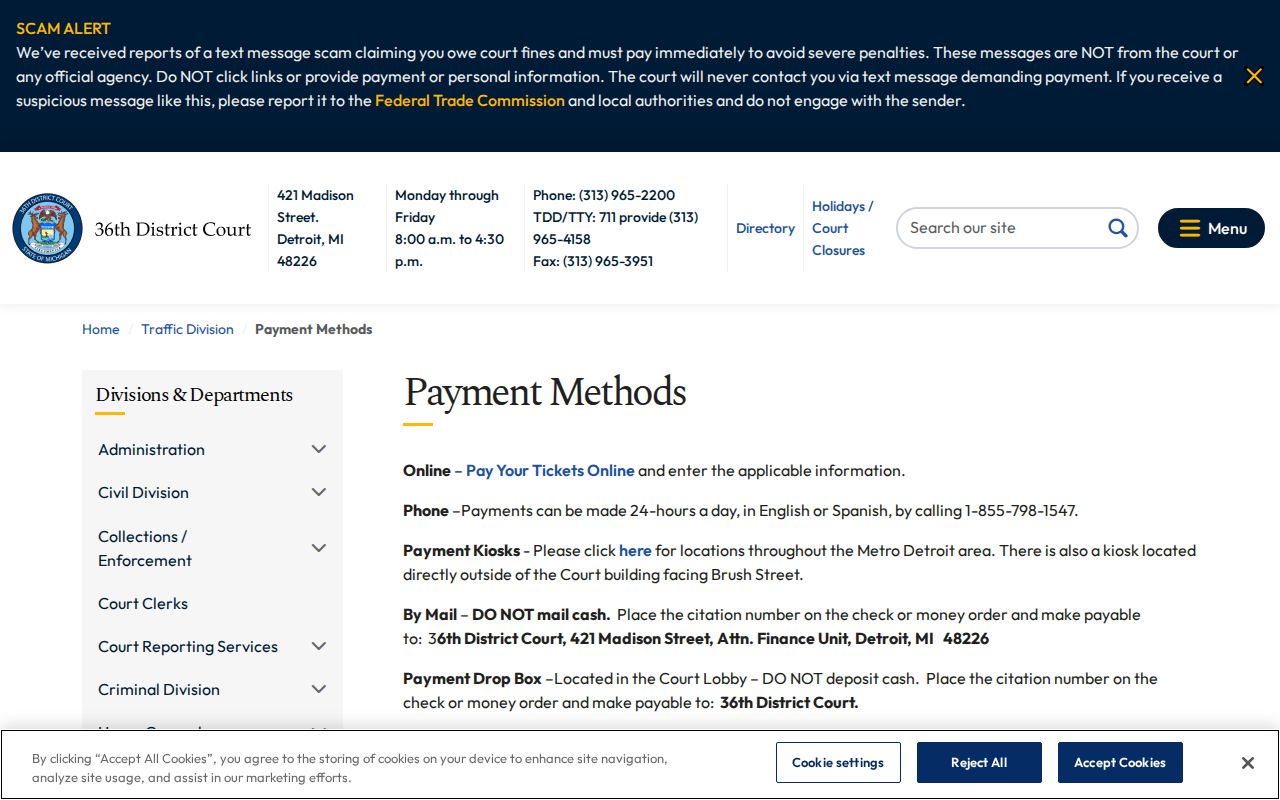
The collections office also takes installment applications, which need an interview and a financial statement. A Detroit payment plan settles money only. It does not automatically clear an appearance requirement, so ask about both.
The 2026 Detroit Amnesty Window
The 36th District Court ran a courtwide Detroit amnesty from March 9 to April 2, 2026. Defendants who paid their original fines and costs got late fees, penalties, and warrant costs waived; driver's license reinstatement fees were excluded. That window has closed. A similar announcement appeared in June 2024, which shows the court revisits amnesty rather than running one continuously. Before counting on a new Detroit amnesty window, check the court's announcements page.
Checking a Detroit Felony at the Third Circuit
Felony charges in Detroit begin downtown. The 36th District Court handles arraignment and the preliminary examination. If the case is bound over, the Third Circuit Court takes over, and its file becomes the one to watch. Odyssey offers public access, but it is unofficial and limited. Images are not posted. Use Odyssey to locate the case, then confirm bond, a recall, or the next appearance with the Criminal Division, since those calls rest with the judge in that Detroit courtroom.
Detroit Warrants and Wayne County
Wayne County spreads warrants across more than twenty district courts, the Third Circuit, and the Sheriff, and Detroit is just one venue inside it. No public county list exists. A Detroit warrant will not appear on one. After an arrest, custody and bond run through the Sheriff and the Criminal Justice Center.
Warrant flow: Detroit police and the 36th District Court › Third Circuit Court on a felony › Sheriff custody and bond when an arrest happens.
The wider county picture, including Sheriff bond rules and the suburban courts, sits on the Wayne County warrant records home page. A Detroit traffic ticket follows the same court route. Details sit on the Wayne County traffic warrants page.
Accessing Detroit Warrant Records
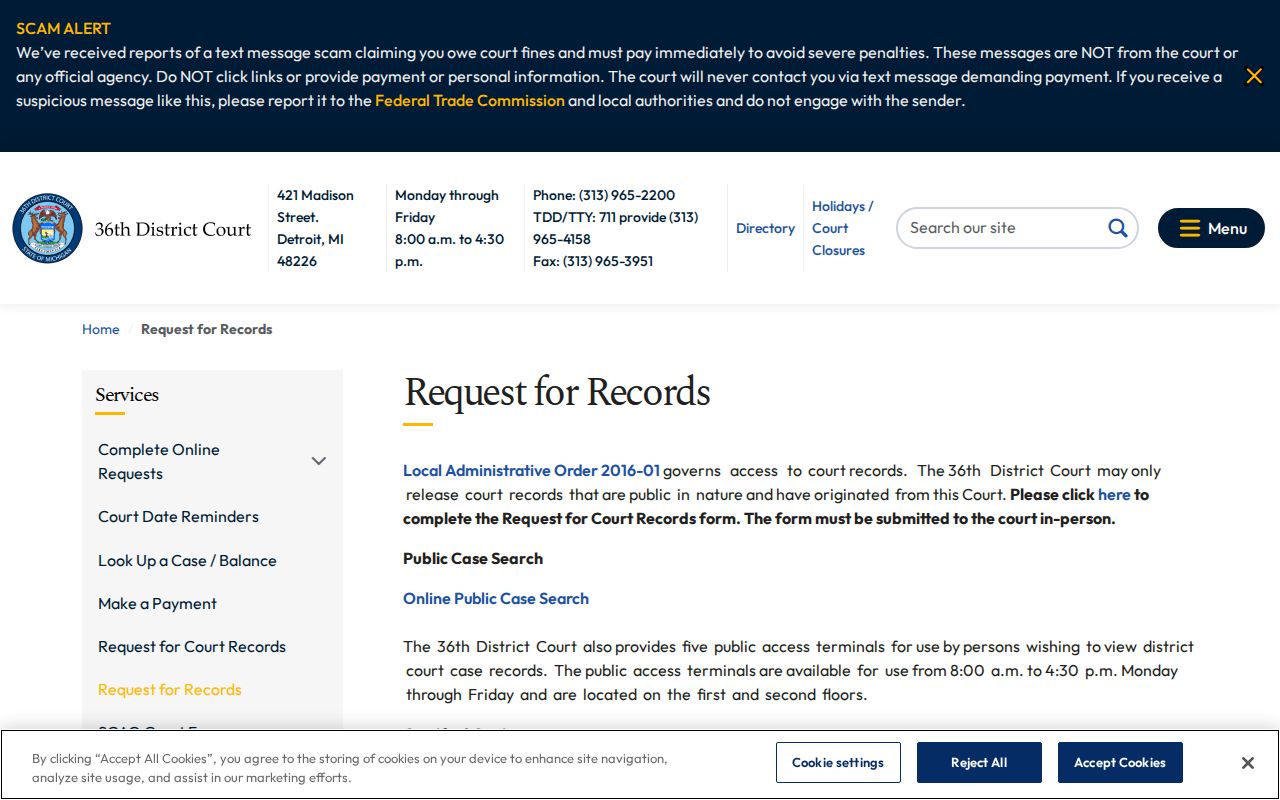
In Detroit, court access follows court rules, not the state records law. The 36th District Court calls its records non-FOIA records. Warrants, fingerprint cards, treatment records, and forensic evaluations stay off limits. The public cannot view them or get certified copies. The records request page explains how to submit the form and what a certified copy costs.
Key Rules:
Michigan Freedom of Information Act, 1976 PA 442 covers Detroit city and Wayne County agency records, not court files.
MCL 764.1c sets the complaint and warrant process, so issuance does not make a warrant a public web record.
MCL 712A.18 limits access to juvenile matter, which routes to the Family Division.